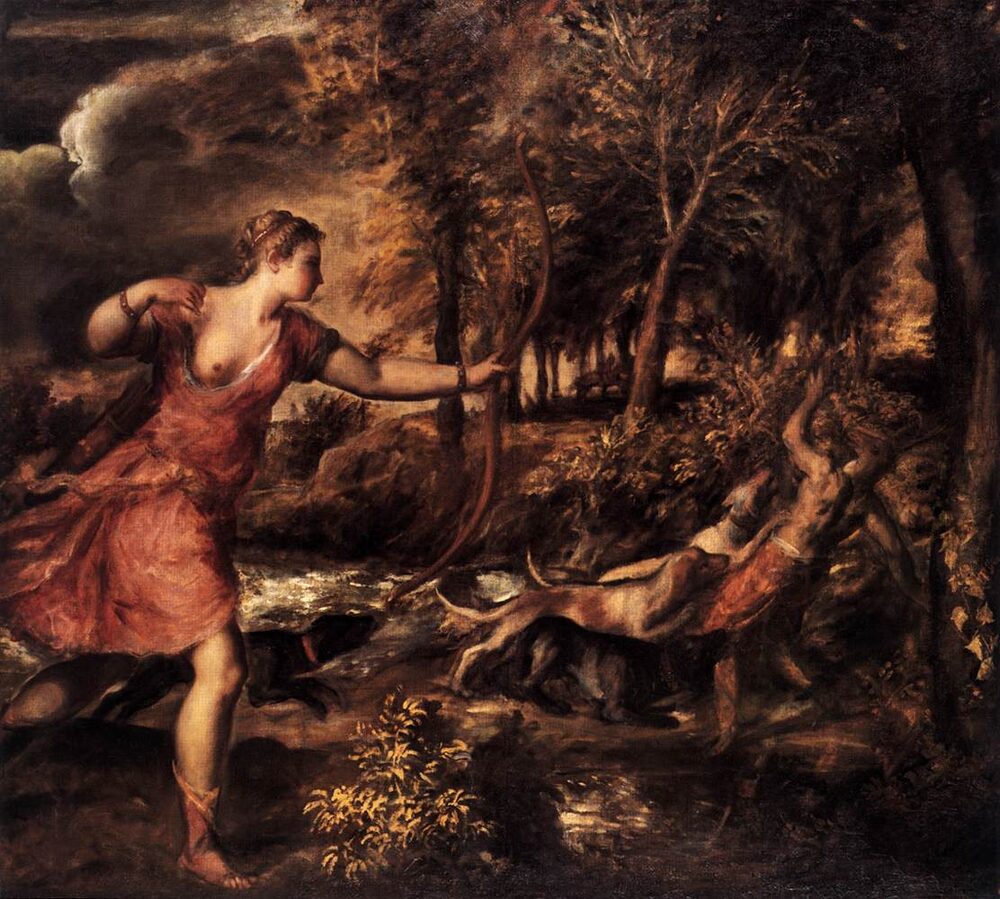
Aktaiōn
First Appearance
Actaeon is old in Greek story, named among the grandsons of Cadmus in the Theban genealogies that go back to Hesiod, and his death was told by the early mythographers Acusilaus and Stesichorus. In the earliest tellings the offence that destroyed him was not that he saw Artemis bathing — that is a later shaping — but that he presumed against the goddess: that he boasted himself the better hunter, or that he wooed Semele and so rivalled Zeus. Euripides already treats the story as common knowledge in the Bacchae (337–340), where Cadmus warns Pentheus to remember the fate of Actaeon, torn raw by the flesh-eating hounds he had reared, because he boasted that he surpassed Artemis in the hunt upon the mountain meadows.
— Hesiod and the early mythographers (Hesiodic Catalogue of Women; Acusilaus; Stesichorus); Euripides, Bacchae 337–340
Who They Are
Actaeon (ak-TEE-on) is the great huntsman of Thebes who was torn to pieces by his own hunting-hounds — a young man of the royal house, grandson of the city's founder Cadmus, who died horribly at the height of his skill and his youth for an offence against Artemis, the goddess of the hunt and of the wild. He is counted among the heroes because he was a mortal prince and a figure of the old Theban saga; but his is a hero's tale turned to tragedy, a story not of triumph but of a man destroyed by the very art that defined him, undone by the hounds he loved and had trained with his own hand.
His parents were Aristaeus, the rustic god of herds, bees, and the useful arts of the countryside, and Autonoe, a daughter of Cadmus and Harmonia — so that Actaeon was nephew to Semele, to Agave, and to Ino, and cousin to Dionysus and to doomed Pentheus, sharing in the long sorrow that fell upon the house of Thebes. In the fullest tradition he was reared on the craft of the chase by Chiron, the wise Centaur of Mount Pelion who taught so many heroes, and he became the finest hunter of his generation, ranging the slopes of Kithairon with a great pack of hounds.
The shape of his death is fixed and famous in every version: the goddess Artemis, in wrath, changed him into a stag, and his own hounds — not knowing their master in the horned beast before them — ran him down and tore him apart, then wandered the mountain afterwards whining and grieving for the master they could not find. What changes from telling to telling is the reason for the goddess's anger, and on that the Greeks never fully agreed.
Mythology
The hunter of the Theban house
Actaeon was born into the royal and ill-fated house of Thebes. His mother was Autonoe, one of the four daughters of Cadmus, the city's founder, and of Harmonia; his father was Aristaeus, a countryside divinity honoured for teaching men beekeeping, cheese-making, the olive, and the herdsman's and hunter's crafts. Through his mother Actaeon stood among a tragic kindred: Autonoe's sisters were Semele, mother of Dionysus and burned up by the sight of Zeus; Agave, who would tear apart her own son Pentheus in the Dionysiac frenzy; and Ino, who leapt into the sea. The daughters of Cadmus were marked for grief, and Actaeon's doom was reckoned among the sorrows of that line (Euripides, Bacchae; Apollodorus, Bibliotheca 3.4.2–4).
In the tradition that became dear to the later Greeks, the boy was given to Chiron, the wise and gentle Centaur of Mount Pelion, to be reared and schooled — the same teacher who trained Jason, Asclepius, and Achilles. Under Chiron, Actaeon learned the whole art of the chase and grew into the finest hunter of his day, master of a great pack of hounds whom he had bred and named and trained himself upon the wooded slopes of Mount Kithairon above Thebes. That mastery, which should have been his glory, became the instrument of his death.
The offence against Artemis — the older Greek versions
Why Artemis destroyed him, the early sources tell differently, and it is worth being plain that the famous detail — that he stumbled upon the goddess bathing — is not the oldest Greek account but a later shaping. The earliest tellers give an offence of presumption, not of accident.
In one strand, going back through the early mythographer Acusilaus (cited by Apollodorus, Bibliotheca 3.4.4), Actaeon's crime was that he wooed Semele — his own aunt — and so set himself as a rival to Zeus, who desired her; for this trespass Zeus, or Artemis acting in the matter, brought his ruin. In another and widely known strand, dramatized by Euripides (Bacchae 337–340) and told by Diodorus Siculus (4.81.4), the offence was a boast: Actaeon claimed to be a better hunter than Artemis herself, or vaunted upon the mountain that he surpassed the goddess in the chase — and some add that he dedicated the spoils of his hunting to her as though a suitor, even wishing to wed the virgin goddess at her own shrine. The lyric poet Stesichorus, in his poem on the subject, told (as Pausanias reports, 9.2.3) that Artemis cast a deerskin about Actaeon on purpose, to bring about his death by his hounds — a version in which the goddess's deliberate anger, not a chance glimpse, is the whole cause.
These older versions share a common moral: the hunter who sets himself level with, or above, the divine mistress of the hunt is struck down by his own art. The offence is pride against a god, the oldest theme in Greek story.
The offence against Artemis — the bathing version (later and Roman)
The telling that the modern world knows best — that Actaeon, wandering the woods at noon, blundered upon Artemis naked in her bathing-pool and was punished for having seen what no mortal man should see — is the later, Hellenistic-and-Roman shaping of the story. Its great monument is the Roman poet Ovid (Metamorphoses 3.138–252), writing in Latin under the name he gave the goddess, Diana.
In Ovid's unforgettable account the young man, his morning's hunting done and his nets and hounds laid by, strays by chance into a secret shaded valley sacred to the goddess, where a clear spring fed a pool. There Artemis was bathing among her nymphs, her bow and quiver set aside. The nymphs, seeing the man, crowded shrieking about their mistress to screen her body; but the goddess stood taller than them all, and the blush of her anger was like the clouds struck red by sunrise. Having no arrows to hand, she flung the water of the spring into his face and spoke her curse — that he should tell, if he could tell, that he had seen Diana unrobed. At once antlers sprang from his wet brow, his neck grew long, his ears sharpened, his hands became hooves, his skin a dappled hide, and the hunter stood transformed into a trembling stag. And with the body of the deer came the terror of the deer: he fled, and marvelled at his own swiftness, and when he caught his reflection in the water would have cried "Wretched me!" — but no voice came. Ovid's version is a masterpiece of pathos precisely because the man keeps his human mind inside the beast's dumb body. This is the version to recognize as the Roman and later one; the Greeks of the classical age more often told the offence of boast or trespass described above.
The hounds and the tearing
However the goddess was angered, the end is the same in every telling: Artemis turned Actaeon into a stag, and his own hunting-hounds, catching the scent of deer and seeing a stag where their master had stood, gave chase. The dogs he had reared and trained ran him down and fell upon him, tearing him to pieces — and he could not call them off, for the stag has no human voice to cry his own name, and so he died beneath the teeth of the pack that loved him, unrecognized. Ovid tells how his companions in the hunt, not knowing, urged the dogs on and called out for Actaeon to come and see the fine kill, wondering that he was absent; and only his groaning, which was neither a man's nor truly a stag's, hung over the place as he died.
A detail the ancients dwelt on is the grief of the hounds afterward. The pack, their blood-work done, ranged whining over the whole mountain seeking their lost master, and could not find him, and would not be comforted. In the tradition reported for Stesichorus and elaborated by later writers, the dogs howled and searched until at last they came to the cave of Chiron, Actaeon's old teacher; and the kindly Centaur, to quiet their grieving, fashioned an image of Actaeon so lifelike that the hounds were soothed, believing they had found him again. It is one of the strangest and most tender grace-notes in all of Greek myth — the faithful dogs mourning the master their own jaws had destroyed.
The naming of the hounds
Because the hounds are the agents of the tragedy, the poets lavished attention on them, and several ancient and later writers set down their names in long catalogues — a roll-call of the famous pack. Ovid (Metamorphoses 3.206–225) names a crowd of them: among them Melampus ("Blackfoot"), Ichnobates ("Tracker"), Dorceus, Pterelas ("Wing-swift"), Laelaps ("Storm-wind"), Theron ("Hunter"), Nape, Harpyia, Ladon, Dromas ("Runner"), Tigris, Leucon ("Whitey"), Asbolos ("Soot"), Lacon, Aello ("Whirlwind"), and many more, some sprung (the poet says) from Cretan and Spartan hunting stock. Later handbooks, such as that under the name of Hyginus (Fabulae 181), give their own lists, which do not always agree — a sign of how the detail grew in the telling, each author adding or renaming dogs. The sheer number — the hounds are often reckoned at fifty — and the loving precision of the names make the horror sharper: these were not wild beasts but a known, named, beloved pack, each dog a familiar, all turned at a goddess's word into the instruments of their master's death.
The place and the aftermath
The mountain of the tragedy is Kithairon (sometimes the neighbouring heights), and the Greeks pointed out the very spots of the story: a spring where the goddess was said to have bathed, and a rock called "Actaeon's bed" (koitē Aktaiōnos) where the weary hunter had once slept. Pausanias, the traveller, records (9.2.3–4) that after Actaeon's death his ghost troubled the countryside, flinging rocks and bringing ruin, until the people asked the oracle at Delphi what to do; the god bade them find whatever remained of Actaeon and bury it, and make a bronze likeness of him and fasten it to the rock with iron — which, Pausanias says, the Plataeans still did in his own time. Thus the hunter torn apart on the mountain was given, in the end, the honours and the binding-rites owed to a restless hero of the land.
Worship — Ancient
A hero of the mountain, not a god of the temple
Actaeon was not a god and had no great cult of his own; he was a hero in the strict Greek sense — a mortal of the old heroic age, remembered at a particular place, whose spirit was thought to linger and to need honour and appeasement. His memory was fixed to the landscape above Thebes and Plataea: to Mount Kithairon, to the spring of the goddess, and above all to the rock called "Actaeon's bed." Pausanias (9.2.3–4) describes the local rite by which his restless ghost was laid — the recovery and burial of his remains, and the iron-bound bronze image fastened to the rock — a classic hero-cult response to a dangerous dead man, keeping him quiet and the land safe.
A warning held up in tragedy and art
More than any shrine, Actaeon lived in the Greek imagination as a cautionary figure — the mortal who came too near the divine and paid for it with his body. The tragedians invoked him so: in Euripides' Bacchae, Cadmus holds up the fate of Actaeon, torn by his own hounds for vaunting against Artemis, as a warning to the proud young Pentheus, who is himself about to be torn apart by his own kin — the echo is deliberate and terrible. Greek vase-painters and, later, wall-painters returned again and again to the moment of the tearing: Actaeon sinking beneath his leaping hounds, sometimes already horned, sometimes still wholly a man with only a fawn-skin or a single antler to mark his doom, with Artemis standing by, bow in hand, as the author of his fate. The story's power as an image of divine anger and human limit kept it alive in cult-memory and in art far more than any altar did.
Worship — Modern
The hunter undone by his own art
Actaeon is remembered today less through devotion than through the sheer force of his story, which has never lost its grip — the man destroyed by the very hounds he loved and the very skill that made him great. For a modern reader drawn to the old religion, he stands at the dark edge of the worship of Artemis: a reminder that the goddess of the wild is not safe, that the hunt is her gift and her jealously guarded prerogative, and that the mortal who forgets the distance between himself and the god — whether by boast, by trespass, or by an unlucky glance — is not spared. Where Artemis is honoured, Actaeon is the shadow that falls across the honouring: the cost of pride, the price of seeing what should not be seen.
A story that would not die
Above all Actaeon lives on in art and poetry, where his transformation has drawn creators for two thousand years — the hunter sprouting antlers, the pool, the goddess's wrath, the loyal hounds turning on their master. The scene has been painted by Titian and a hundred others, set to music, and made the subject of poems in every age, for it holds in one image several of the deepest human fears at once: the body betraying the mind, the beloved turning deadly, and the terrible nearness of the sacred. A thoughtful honouring of his memory keeps to the note the Greeks themselves struck — not triumph but pity and awe: pity for the young hunter who meant no harm (in the later telling) and yet was torn apart, and awe before the power that could unmake a man with a handful of flung water.
Epithets & Cult Titles
- ho Thēbaios (ὁ Θηβαῖος) — The Theban — Actaeon belonged to the royal house of Thebes, grandson of its founder Cadmus through his mother Autonoe; his whole story unfolds on the mountains above the Theban plain
- kynēgos (κυνηγός) — The huntsman / hound-leader — his defining character, the master of hounds trained from boyhood to the chase, undone in the end by the very art that named him
- mathētēs Cheirōnos — Pupil of Chiron — in the tradition that he was reared and taught the hunter's craft by the wise Centaur of Mount Pelion, who schooled so many heroes
- elaphos (ἔλαφος) — The stag — the beast he was made to become, horned and dumb and hunted, so that his hounds could not know their master in the deer they ran down
Sources & Variants
- Hesiod / the Hesiodic Catalogue of Women (Actaeon among the grandsons of Cadmus in the Theban genealogy; the early tradition of his death)
- Acusilaus (cited in Apollodorus, Bibliotheca 3.4.4 — Actaeon destroyed because he wooed Semele and so rivalled Zeus; the older, pre-bathing offence)
- Stesichorus (reported in Pausanias 9.2.3 — Artemis cast a deerskin about Actaeon to bring about his death by his own hounds)
- Euripides, Bacchae 337–340 (Cadmus recalls Actaeon torn by his flesh-eating hounds for boasting he surpassed Artemis in the hunt — used as a warning to Pentheus)
- Apollodorus, Bibliotheca 3.4.2–4 (Actaeon son of Aristaeus and Autonoe, reared by Chiron; the bathing version and the rival version from Acusilaus both reported; the naming and grief of the hounds)
- Pausanias, Description of Greece 9.2.3–4 (the rock 'Actaeon's bed' on the way to Plataea; the restless ghost, the Delphic oracle, and the iron-bound image; Stesichorus's deerskin version)
- Diodorus Siculus, Bibliotheca 4.81.4 (Actaeon destroyed for dedicating his hunting-spoils to Artemis as a suitor and vaunting himself the better hunter, even wishing to wed the goddess)
- Ovid, Metamorphoses 3.138–252 (the full bathing version: the chance trespass on Diana's pool, the flung water and curse, the transformation into a stag, the catalogue of the hounds, and the death) — later Roman retelling
- Hyginus, Fabulae 180–181 (the death of Actaeon and a catalogue of the hounds' names) — later Latin handbook
Gallery