Achilleus
First Appearance
Achilles is the subject of the very first word of European literature: the Iliad opens "Mēnin aeide, thea, Pēlēïadeō Achilēos" — "Sing, goddess, of the wrath of Achilles, son of Peleus," the ruinous anger that sent countless brave souls of heroes down to Hades and left their bodies as carrion for dogs and birds. From its first line the poem names him not by his strength but by his rage and the grief it brings, and everything that follows unfolds from it.
— Homer, Iliad 1.1–7
Who They Are
Achilles (uh-KILL-eez) is the greatest of the Greek warriors at Troy and the central figure of the Iliad, the oldest and most influential poem of the Western tradition. He is the son of the mortal king Peleus of Phthia and the sea-goddess Thetis, a Nereid — a hero born of a divine mother and a human father, and marked from birth by that divided nature. Half his blood is immortal and half is mortal, and the tragedy that the Greeks felt in him grows straight out of that division: he is very nearly a god in his speed, his beauty and his terrible strength, and yet he must die, and he knows it more clearly than any other hero in myth.
His story turns on a single, unbearable choice. It was foretold to him that two fates lay open, and that he would have to choose between them: a long, quiet, obscure life at home in Phthia, growing old among his people and forgotten by history; or a short life at Troy, blazing and glorious, ending young but winning kleos aphthiton — "undying fame," a name that would never die. This choice between the long dim life and the short bright one is the beating heart of Achilles, and the Greeks returned to it as the deepest question their heroic ideal could ask: what is a glorious death worth, set against a long and gentle life?
He is also, and above all, a study in rage and grief. (Content note: his story turns on wartime killing, the death of those he loves, and the abuse of an enemy's body; it is told here frankly but without dwelling on gore.) The Iliad is not the story of the Trojan War entire but of a few weeks of it, and its true subject is the mēnis — the wrath — of Achilles: his furious quarrel with his own commander, his withdrawal from the fighting, the catastrophe that follows, the death of his dearest companion Patroclus, and the even more terrible rage that grief unleashes in him. That he can move, at the very end, from that rage to a moment of shared human sorrow with the father of the man he has killed is what makes him not merely the strongest of the heroes but the most fully human.
Mythology
Two fates: the choice between the long life and the short
The prophecy that shapes Achilles' whole life was given, in the Iliad's own telling, through his mother Thetis: two destinies (kēres) were carrying him toward death, and he might choose between them. "If I stay here and fight around the city of the Trojans," he says, "my homecoming is lost, but my glory (kleos) will be undying; and if I go home to my dear native land, my glory is lost, but my life will be long, and death will not come to me quickly" (Iliad 9.410–416). This is the central theme of everything told about him. He is the one hero who is offered, and who understands, the exact terms of the heroic bargain — a short life exchanged for a name that outlasts every long and comfortable life that history forgets. When at last he chooses to return to battle knowing it seals his early death, he is not swept along by fate but consciously accepting it, and that clear-eyed acceptance is what raises the Iliad above a simple war-story into a meditation on mortality itself.
The vulnerability, told two ways
Achilles' famous vulnerability comes down to us in two distinct traditions, and it matters greatly which is which. In the older, Homeric tradition, Achilles is not invulnerable at all. He is the supreme warrior — faster, stronger, more terrible than any other man at Troy — but he is a mortal who can be wounded and who is doomed to die, and the poem never once suggests that weapons cannot pierce him. His greatness in the Iliad is precisely the greatness of a mortal who fights knowing he will fall; his invulnerability would drain the story of its meaning. When Homer's Achilles goes to his death it is as a man, and the wonder of him is his courage in the face of a death he cannot escape.
The invulnerable Achilles — dipped in the Styx and vulnerable only at the heel — is a later development, not found in Homer. In this tradition, best preserved in the Roman poet Statius (Achilleid 1.269–270, first century CE) and other late sources, the goddess Thetis, trying to make her infant son immortal, carried him down to the underworld river Styx and dipped him in its death-cold waters, holding him by one heel. Everywhere the water touched, his skin became proof against any weapon — but the heel her fingers covered stayed dry, and stayed mortal. From this late story comes the phrase every language now keeps: an "Achilles' heel," the one fatal weakness in something otherwise unassailable. It is a beautiful image and a very old idea of the almost-immortal hero, but it belongs to the centuries after Homer, and the two Achilleses — the mortal warrior of the Iliad and the invulnerable hero of the later poets — should be held apart and not blended into one.
Hidden on Skyros (a later tale)
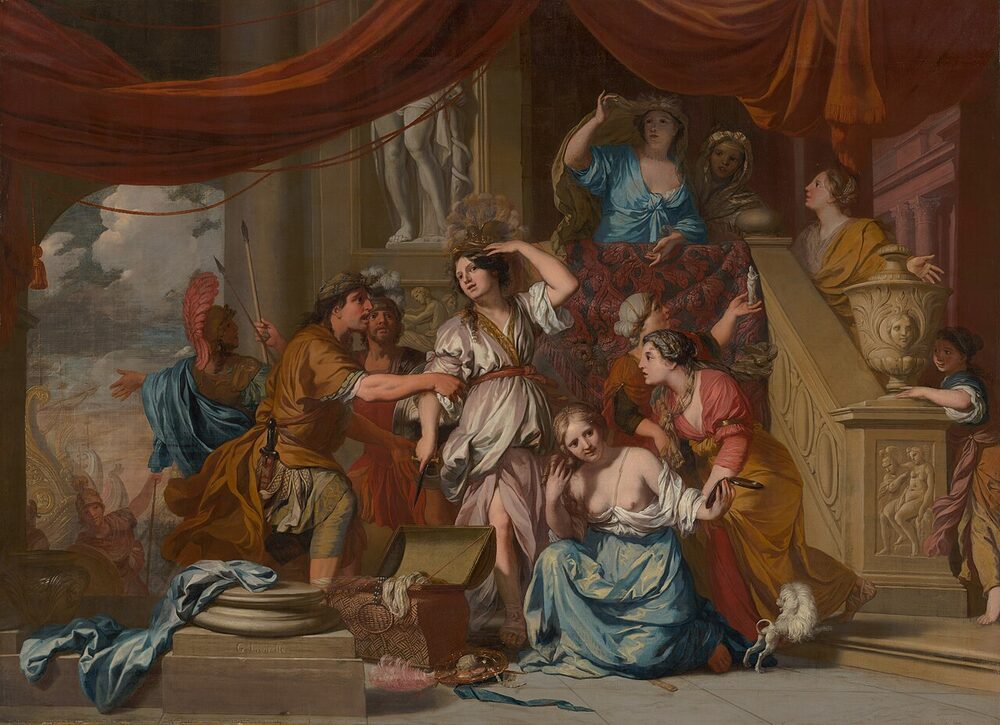
Another episode outside Homer tells how Achilles nearly missed the war altogether. Knowing by prophecy that her son would die at Troy, Thetis hid the young Achilles on the island of Skyros, disguised as a girl among the daughters of King Lycomedes, so that he would not be found and taken to the fighting. (This story too is post-Homeric, elaborated by later authors such as Apollodorus and again Statius; the Iliad knows nothing of it.) But the Greeks had learned that Troy could not fall without Achilles, and Odysseus, ever the trickster, came to Skyros to uncover him. In the best-known version Odysseus spread out gifts before the king's daughters — jewellery and fine cloth, and among them a shield and a spear — and then had a war-trumpet sounded, or a sudden alarm raised; while the girls fled, Achilles instinctively seized the weapons, and so gave himself away. Uncovered, he went willingly to Troy and to the fate he had been born for. During his time on Skyros the tradition places his union with Lycomedes' daughter Deidamia and the birth of his son Neoptolemus, who would come to Troy after his father's death.
The wrath of Achilles: the quarrel and the withdrawal
The Iliad proper begins in the tenth year of the war with a quarrel. When a plague sent by Apollo forces Agamemnon, the Greek commander-in-chief, to give up a captive woman, he seizes Briseis — a war-prize allotted to Achilles — to salve his wounded pride. To Achilles this is not merely the loss of a woman he cared for but a public stripping of his honour (timē) by a lesser man, and it is the deepest wound a heroic warrior can take. In fury he withdraws himself and his Myrmidons from the fighting altogether, and he asks his mother Thetis to beg Zeus that the Greeks be driven back and slaughtered at their ships until they are forced to see how much they need him. Zeus consents, and so the hero's private rage becomes a public catastrophe: for many books of the poem Achilles sits idle by his ships while the Trojans, led by Hector, drive the Greeks back to the sea and set their vessels alight. Even a desperate embassy from Agamemnon, offering the return of Briseis and vast treasure, cannot move him — it is on this embassy that he speaks the choice of the two fates.
Patroclus, and the grief that remakes the rage
What finally breaks the deadlock is love and grief, not gifts. Achilles' dearest companion is Patroclus, the gentle older friend who has been at his side since boyhood — the person he loves most in the world. (Later antiquity, and many readers since, understood the bond between them as that of lovers; Homer does not label it, but its depth is beyond question and it is the emotional core of the poem.) Unable to bear the sight of the Greeks dying, Patroclus begs to be allowed to enter the battle wearing Achilles' own armour, to frighten the Trojans and give the exhausted Greeks respite. Achilles consents, but warns him only to drive the enemy from the ships and not to press on toward Troy. Patroclus, carried away by success, forgets the warning — and beneath the walls of Troy he is struck down: dazed by Apollo, wounded, and then killed by Hector, who strips Achilles' armour from his body. When the news reaches Achilles his grief is so violent that he pours ash over his head and lies in the dust, and his cry brings Thetis up from the sea. Now his wrath finds a new and far more terrible object. He will return to the war — knowing, and openly saying, that his own death must follow soon after Hector's — not for Agamemnon or for glory but to avenge Patroclus.
The return to battle and the killing of Hector
Because Hector has taken his armour, Thetis goes to the smith-god Hephaestus, who forges Achilles a new and wonderful set of arms, including the great shield whose making Homer describes at length — a whole world of peace and war, city and countryside, hammered onto its surface. Armoured anew and blazing with rage, Achilles storms back into the fighting and drives the Trojans before him in a slaughter so vast that the river Scamander itself rises against him, choked with the dead. At last he comes face to face with Hector before the walls of Troy. Hector's nerve fails and he runs, and Achilles chases him three times around the city; then Athena tricks Hector into standing, and Achilles kills him with a spear-thrust to the throat. Dying, Hector begs that his body be given back to his family for burial; Achilles, still consumed by grief and rage, refuses with contempt, and in the days that follow he lashes Hector's corpse to his chariot and drags it round the tomb of Patroclus again and again — an act of desecration that even the watching gods find unbearable.
The ransom of Hector: rage giving way to sorrow
The Iliad does not end in vengeance but in an extraordinary scene of shared grief. Guided by the gods and by Hermes through the night, old King Priam of Troy comes alone and unarmed into the very tent of the man who killed his son, and kneels, and does the thing no man has done before: he kisses the hands of Achilles, "the terrible, man-slaying hands that had killed so many of his sons" (Iliad 24.478–479), and begs for Hector's body, asking Achilles to remember his own father Peleus, an old man far away who longs for a son he will never see again. The appeal breaks through Achilles' rage at last. The two of them, the young killer and the bereaved old king, weep together — Priam for Hector, Achilles for Patroclus and for his own father and his own approaching death — and Achilles, gentled by a grief he now shares, gives the body back and grants a truce for the funeral. In this moment the wrath that opened the poem is finally spent, and the greatest of warriors becomes, for a night, simply a man who understands another's sorrow. It is the note on which the Iliad chooses to end.
The death of Achilles
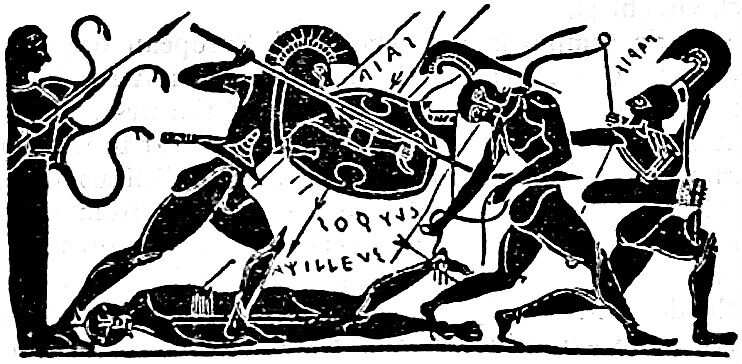
Homer's Iliad closes before Achilles dies, but his death is foretold within it again and again, and the fuller story was told in the lost epics of the Trojan cycle and by many later authors. After Hector's fall Achilles goes on fighting and winning until, near the Scaean Gate of Troy, he is struck down — not by a great warrior but by Paris, Hector's brother and the unwarlike prince whose theft of Helen began the war. Paris shoots an arrow, and Apollo, who has favoured Troy throughout and whose priest Achilles' side had dishonoured, guides the shaft to its mark. In the later tradition of the vulnerable hero, the arrow finds the one mortal spot, the heel; and so the greatest of the Greeks is brought down by an arrow from the weakest of his enemies, god-guided, at the gate of the city he could not quite live to take. His body was fought over and rescued, mourned by the Greeks and by his mother and her sister Nereids rising from the sea, and his ashes were laid, the tradition held, together with those of Patroclus, so that the two who could not be parted in life lay mingled in death.
Worship — Ancient
A hero raised toward a god
Achilles was not a god of the Olympian kind but a hero in the technical Greek sense — a powerful dead mortal honoured with cult at his tomb, believed to remain present and potent in the place where his bones lay and able to help or harm the living. Yet of all the Greek heroes he was worshipped the most widely and the most fervently, and in some places his cult rose so high that he was addressed almost as a god. His worship spread far beyond his Thessalian homeland, carried especially by Ionian and Milesian settlers around the shores of the Black Sea, where he became one of the great protecting powers of the region.
The tomb at Sigeion and the Troad
The most famous of his cult sites was his tomb in the Troad, a great mound shown on the shore near Sigeion by the Hellespont, close to the plain where he had fought. Sailors passing saw it from the sea, and pilgrims came to pour libations and make offerings to the hero there. Its fame drew the greatest visitor of all: Alexander the Great, crossing into Asia in 334 BCE, made a point of honouring Achilles at this tomb — anointing the grave-mound, running a race around it naked with his companions in the old heroic manner, and laying a wreath, while (the story goes) declaring Achilles fortunate above all men to have had Homer to proclaim his fame. Alexander, who carried a copy of the Iliad on campaign and modelled himself on Achilles, made the hero's cult a piece of his own legend.
Leuke, the White Island: Achilles as lord and god
The most remarkable centre of his worship lay far out in the Black Sea, on the island of Leuke ("the White Island," today Snake Island off the mouth of the Danube). A widespread tradition held that after his death Achilles had not gone down to the ordinary underworld but had been carried by Thetis to this blessed island, where he lived on in a kind of paradise — and there he was worshipped with a temple and cult statue as the ruling lord of the island, honoured as a god. Sailors told of hearing him singing Homer's verses across the water, or of glimpsing him on the shore; ships put in to sacrifice to him and to leave dedications, and mariners in danger prayed to him for rescue. Archaeology has recovered from the island many inscribed offerings addressed to Achilles as lord of Leuke, confirming a real and long-lived cult. In some versions of the tradition he shared the island — and a blessed afterlife marriage — with Helen, or with Iphigenia or Medea, in a hero's paradise beyond death.
Olbia and the Achilles Pontarches
On the northern Black Sea coast, the Greek city of Olbia and its neighbours honoured Achilles as Pontarches, "Lord of the Sea" or "Ruler of the Black Sea" (Pontos) — a title recorded on numerous surviving dedications and inscriptions, in which magistrates and citizens gave thanks and offerings to the hero as a protecting power of their waters. A long, low sandy spit nearby was called the "Racecourse of Achilles" (Dromos Achilleos), where games were held in his honour. In these Pontic cities Achilles had risen from a hero of old song to a living civic god of the sea, worshipped as steadily as any Olympian — a striking testament to how far the reverence for the Iliad's mortal hero could carry.
Worship — Modern
Honouring Achilles today
Achilles is a hero rather than a god, and a modern person who wishes to honour him does so in the spirit of hero-reverence: remembering a great and tragic figure of the dead, and drawing meaning from his story, rather than praying to a ruler of the cosmos. Those drawn to him are often people who feel the pull of his central question — what it means to live fully and briefly rather than long and unremarked, what excellence costs, and how grief and love can remake a person. A simple way to honour him is to keep his memory: to read the Iliad, especially its first and last books, and to sit with the choice of the two fates and the reconciliation of Achilles and Priam. He is a natural patron for athletes, soldiers and veterans, and for anyone wrestling with rage, grief, or the weight of an early loss.
Offerings and remembrance
In the ancient manner, offerings to a hero were poured rather than burnt — libations at the tomb or the shore. A modern devotee might pour out a libation of wine, or of honey and water, in his memory, or set aside a small offering at a quiet place, particularly by the sea, which belonged to his mother's people and became his own domain at Leuke. Because so much of his cult clustered on the coast and among sailors, the sea is his fitting shrine. An offering in keeping with the man is also an act rather than an object: a race run, a hard training borne, a poem or passage of Homer read aloud in his honour — for Achilles himself, in the Iliad, is found singing to the lyre "the glorious deeds of men" in his tent, and song was always close to him.
Legacy
No figure of Greek myth has left a longer shadow than Achilles. The "Achilles' heel" has become the common name in every European language for a single fatal weakness. His wrath is the subject of the first word of the Iliad and so, in a real sense, the opening note of all Western literature, and the poem's meditation on mortality, honour, love and grief has never stopped being read. Alexander the Great shaped his own life around him; poets from Aeschylus and the Greek tragedians through Statius, and on to modern novelists and poets, have retold and reimagined him. He endures because he asks, more starkly than any other hero, the question at the centre of the heroic ideal and of any mortal life: whether it is better to burn briefly and be remembered, or to live long and be forgotten — and because, at the last, he answers a different question altogether, showing that even the most terrible rage can give way to shared human grief.
Epithets & Cult Titles
- podas ōkus (πόδας ὠκύς) — Swift-footed — Homer's most constant standing epithet for Achilles, marking the speed that no Trojan could outrun
- Pēleidēs / Pelides (Πηλείδης) — Son of Peleus — the patronymic by which the Iliad names him again and again, binding him to his mortal father
- Aiakidēs / Aeacides (Αἰακίδης) — Descendant of Aeacus — his grandfather, the just king who became a judge of the dead; a title of his heroic lineage
- thumoleōn (θυμολέων) — Lion-hearted — of a spirit like a lion's, both in courage and in the wildness of his rage
- ptoliporthos (πτολίπορθος) — Sacker of cities — the raider who took twelve cities by sea and eleven by land before the wrath of the Iliad ever began
- dios Achilleus (δῖος Ἀχιλλεύς) — Godlike, brilliant Achilles — the shining hero, near-divine in his mother's blood though mortal in his father's
Sources & Variants
- Homer, Iliad — the whole poem, esp. 1.1–7 (the wrath), 1.148–246 (the quarrel with Agamemnon), 9.307–429 (the embassy and the choice of two fates), 16 (the death of Patroclus), 18.22–137 (Achilles' grief and Thetis), 18.478–608 (the shield of Achilles), 22.131–404 (the killing of Hector), 24.468–676 (the ransom of Hector by Priam)
- Homer, Odyssey 11.467–540 (Achilles' shade in the underworld, wishing he were a living serf rather than king of the dead); 24.36–94 (his funeral and the mingled ashes with Patroclus)
- Statius, Achilleid 1.269–270 (Thetis dipping the infant in the Styx by the heel) and 1.207–396 (Achilles hidden on Skyros and uncovered by Odysseus) — Roman, first century CE, the invulnerable and heel traditions
- Apollodorus, Bibliotheca 3.13.6–8 (the dipping, the hiding on Skyros, Deidamia and Neoptolemus) and Epitome 4.1–5.5 (the war, the death of Patroclus and Hector, the death of Achilles by Paris and Apollo)
- Pindar, Nemean and Olympian odes, and the fragmentary epics of the Trojan Cycle (Cypria, Aethiopis, Little Iliad) — the death of Achilles and his afterlife on Leuke
- Philostratus, Heroicus and On the White Island; Arrian, Periplus of the Euxine Sea 21–23 (the cult of Achilles on Leuke and as Pontarches on the Black Sea)
- Pausanias, Description of Greece 3.19.11–13 (Achilles on Leuke, married to Helen) and passim for his hero-cults
- Plutarch, Life of Alexander 15 (Alexander honours Achilles at his tomb in the Troad); Strabo 13.1.32 (the tomb at Sigeion)
Gallery